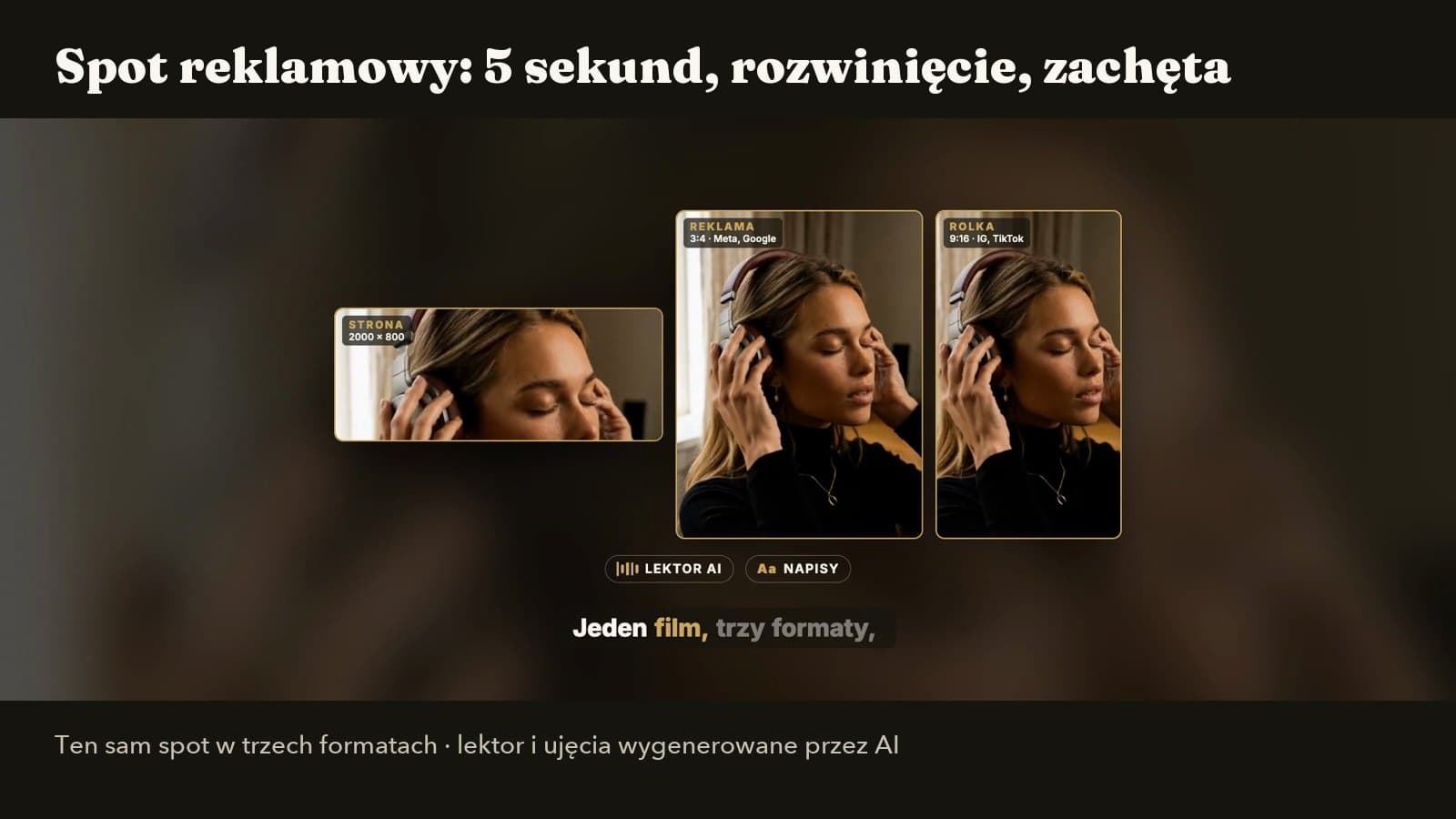
A few days ago my friend Kuba replied to my idea for new video ads with one long text message. The point was this: businesses need the same video in several places at once. On their website at roughly 2000 by 800 pixels, in Meta and Google ads at 3:4, and as reels. Ideally with a voice-over and captions. And then the line that stuck with me: in a paid ad the first five seconds have to be fast and show what it is about, then the build-up, then the call to action.
Sounds obvious. Yet most spots I see from small businesses do the opposite: they open with a logo, warm up slowly, and the key sentence lands at second 20, when almost nobody is watching. I gathered the data, checked what big brands do, and made the first such spot for our own brand. Here is what I learned.
Why five seconds
Meta (then Facebook) and Nielsen found that up to 47% of a video campaign's value is delivered in the first three seconds and up to 74% in the first ten (Meta for Business). To be fair: that study is from February 2016, before reels. Everything since then points the same way. The same analysis showed that 65% of people who watch the first three seconds stay for at least ten, and 45% make it to thirty.
Meta also found that 41% of video ads were basically meaningless without sound, and captioned ads increased view time by 12% on average. Captions are not decoration, they are half of the message.
Context: according to Sensor Tower data reported by CNBC in January 2026, reels took 46% of the time US users spent on Instagram in 2025, up from 37% a year earlier. A 2023 Meta and Nielsen study found that videos shorter than 15 seconds performed best for promotions (Social Media Today).
Structure: hook, build-up, call to action
| Part | Time | What happens | Mistake I avoid |
| Hook | 0–5 s | product, problem or a question, from the first frame | a logo and title card first |
| Build-up | 5–15 s | one benefit and one proof | listing five benefits at once |
| Call to action | last 3–5 s | one action: buy, sign up, message | a vague "visit us" |
In our spot the hook is the line "You have five seconds" with a countdown from five to zero in the corner. Then a phone recording turns into a spot and the same video appears in three frames. It ends with one offer: the first reel is free.
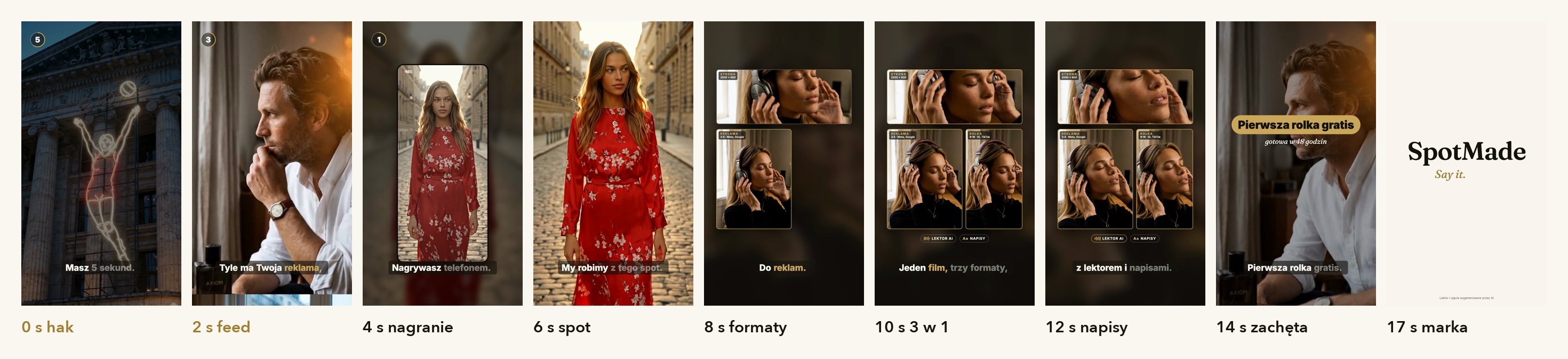
Three formats from one recording
- •9:16 (1080×1920): Reels, Stories, TikTok, YouTube Shorts. Key content stays away from the bottom and right edge where apps put buttons.
- •3:4 or 4:5: the feed in Meta and Google ads, re-laid out, not a cropped vertical.
- •2000×800: a video banner for your website, with burned-in captions because it plays muted.
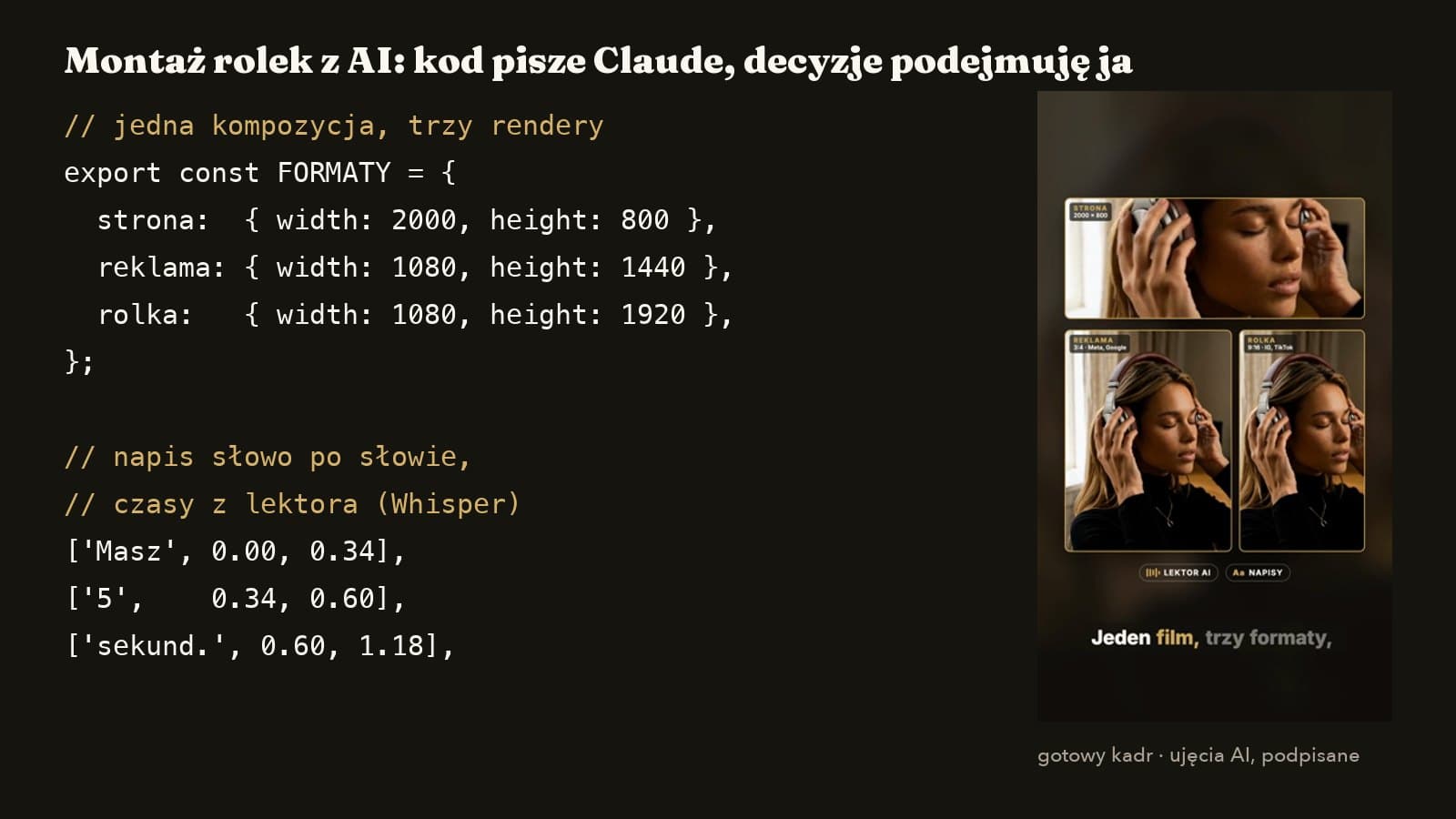
I build it in code: one composition that lays itself out for any width and height, and three renders.
AI voice-over: yes, but labelled
I generated the voice-over with ElevenLabs. Four takes cost about 17 cents in credits. But a Tears of Joy survey from October 2026 found that more than half of Poles trust a brand less when its ad was made with AI, and 73% of 18–24-year-olds do after seeing an AI label (Instalki.pl).
Big brands still use it, openly: Erste Bank Polska shows an AI-generated parrot on its homepage with a clear "AI-generated" label. And Media Expert ran one video ad on Google Ads in six variants from 11 September to 11 October 2026 (Google Ads Transparency Center), which is exactly what editing in code makes cheap: change the hook, render, test. People do not hate AI, they hate AI that pretends. So I always show the real product, use AI for the craft, and label everything.
Checklist
- •The product or problem is visible in the first second, not a logo.
- •The hook works without sound.
- •Captions run word by word.
- •One benefit, one proof.
- •15–20 seconds in total.
- •One clear call to action.
- •Nothing important in the 9:16 button zones.
- •The 3:4 version is re-laid out.
- •Loudness is even (about −14 LUFS).
- •Everything made by AI is labelled.