Labeling AI content is no longer an ethical nicety — it is becoming a legal and platform obligation. If your brand uses AI-generated images, video, or voice in marketing, PR, or social media, three things now decide whether you stay out of trouble: the C2PA standard (Content Credentials), the EU AI Act, and the rules of Meta and TikTok. This guide explains what to label, how, and where, so your brand does not get caught out.
Why this matters for your brand right now
The era of "no one will notice it's AI" is over. Platforms now detect generated content automatically, the EU has passed a regulation with real deadlines, and audiences punish anything that smells of a hidden trick. For a brand, the risk is not just a fine. It is the loss of trust you cannot buy back — when a customer realizes your "real" testimonial or "authentic" photo was generated and nobody admitted it.
The good news: labeling done well is not a weakness. Done transparently, it is a signal of professionalism. The brands that win are the ones that say openly "this was created in an AI studio" — and do it so cleanly that the audience treats it as craft, not a trick.
What is C2PA and Content Credentials
C2PA (Coalition for Content Provenance and Authenticity) is an industry standard backed by Adobe, Microsoft, Google, OpenAI and others. In practice it means an invisible "nutrition label" attached to a file — cryptographically signed metadata that records how the material was created: which tool, whether AI was involved, what edits were applied.
Content Credentials is the consumer-facing implementation of that standard. More and more tools (Adobe Firefly, Photoshop, some camera makers) automatically stamp files with this data. The user sees a small "CR" icon and can check the file's history.
What this means for your brand: if you produce AI material, you can — and increasingly should — keep the Content Credentials intact rather than stripping them. Removing the metadata to "hide" the AI origin is exactly the move that backfires when a platform detects it anyway.
What the EU AI Act requires
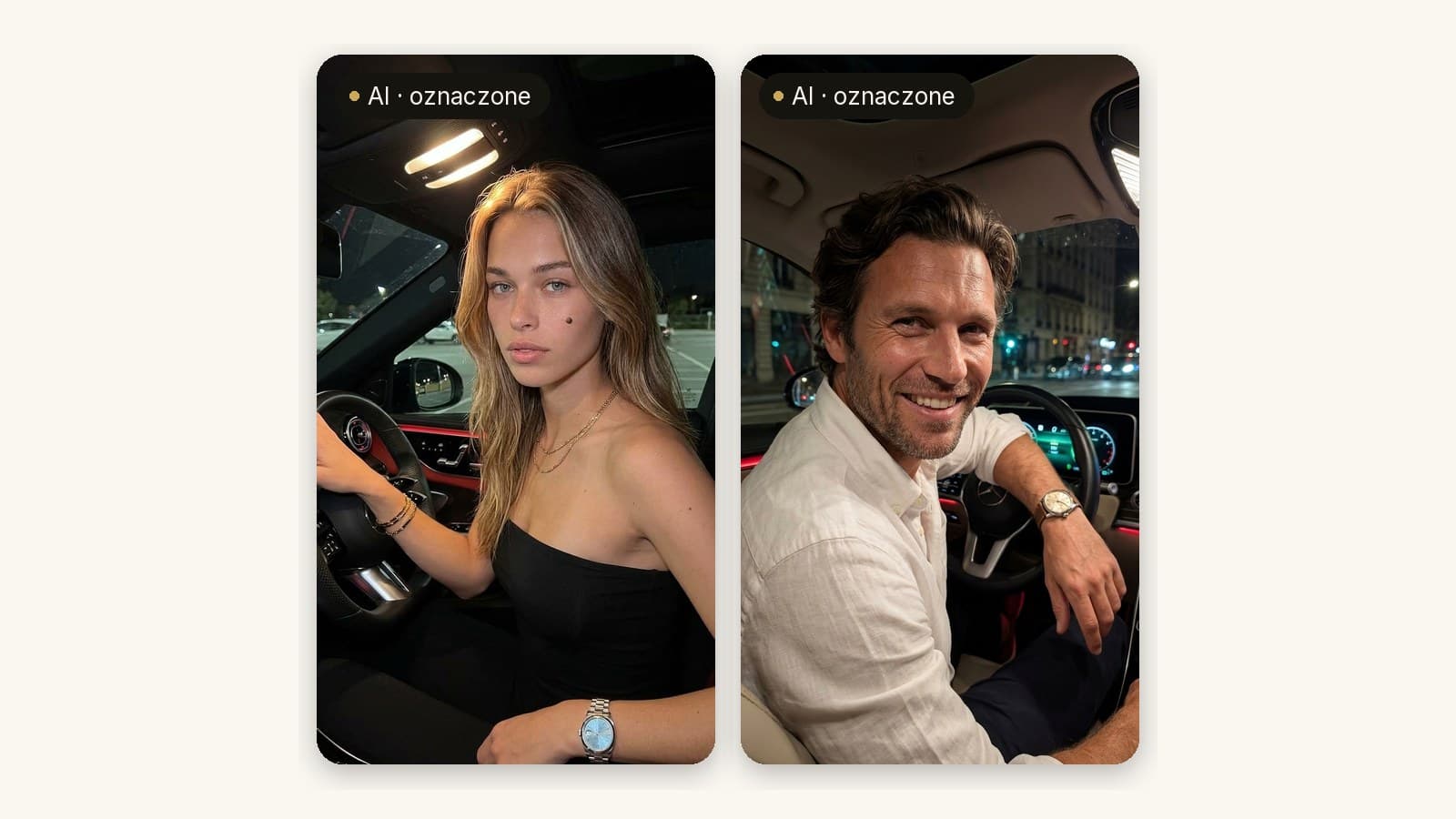
The EU AI Act is the first comprehensive AI regulation in the world, and it carries transparency obligations that hit marketing directly. The key point for brands is Article 50: content generated or significantly modified by AI must be labeled in a machine-readable way, and deepfakes (realistic images, audio, or video of people or events) must be clearly marked as artificially generated.
In practice this means:
- •If you publish a realistic image of a person who does not exist, or who never was in that place, you label it as AI-generated.
- •If you generate a voice or video of a real person, the consent and labeling bar is even higher.
- •The disclosure must be clear and visible at the moment the audience consumes the content — not buried in a footer.
The transparency obligations of the AI Act phase in through 2026, with penalties that can reach a percentage of global turnover. You do not want to learn the exact figures from your own case.
Meta and TikTok rules — what platforms already enforce
Regulation is one thing, platforms are another — and they enforce faster. Meta (Facebook, Instagram) and TikTok already require disclosure of AI-generated content and add their own labels.
- •Meta: in account settings there is an option to mark content as "AI info." Realistic AI material can get an automatic label, and accounts that repeatedly fail to disclose risk reduced reach.
- •TikTok: a mandatory "AI-generated content" toggle when publishing, plus automatic detection of C2PA metadata. TikTok was among the first platforms to read Content Credentials and label material on its own.
The practical conclusion: if you do not label it yourself, the platform may do it for you — usually in a less flattering way, and sometimes with a reach penalty for trying to hide it.
How to label AI content in practice — a checklist
Below is the minimum we use ourselves and teach in our workshops:
- •Keep the metadata. Do not strip Content Credentials from exported files. If your tool adds C2PA, leave it.
- •Use the platform toggle. On every realistic post on Meta and TikTok, switch on the AI-content disclosure. It takes a few seconds.
- •Label visibly when it matters. For deepfakes and realistic depictions of people, add a clear note in the description or graphic ("AI-generated material").
- •Document consent. If you generate a real person's face or voice, get written permission. The AI Act and platforms treat this far more strictly than a generic "AI photo."
- •Standardize internally. Set one rule for the whole team: what gets labeled, how, and who checks before publishing. Chaos here is how mistakes slip through.
What you do NOT have to label — and where the line sits
Not every use of AI requires a banner. Color correction, retouching, background removal, AI-assisted editing of a real photo — these usually do not require disclosure as "AI content." The line runs at realism and deception: the question is whether the audience could mistake a generated thing for a real one. The closer you get to a realistic person, event, or testimonial that did not happen, the higher the labeling bar.
This is exactly the gray zone where most brand mistakes happen — not from bad intent, but from not knowing where the threshold sits. Which is the part worth investing in.
Summary — turn labeling into a trust advantage
AI content labeling is no longer optional. C2PA gives you the technical tool, the EU AI Act sets the legal frame, and Meta and TikTok already enforce their own rules. For a brand the strategy is simple: keep the metadata, use the platform toggles, label deepfakes clearly, and document consent. Do this consistently and labeling stops being a risk — it becomes proof that you work like a studio, not a generator.
If you want your team to run this confidently — knowing exactly what to label, how, and where, without overdoing it or getting caught out — that is part of what we cover in our workshops. For companies, marketing, and PR teams, write to partners@spotmade.com. Creators can book a 1:1 workshop through the /szkolenia page.