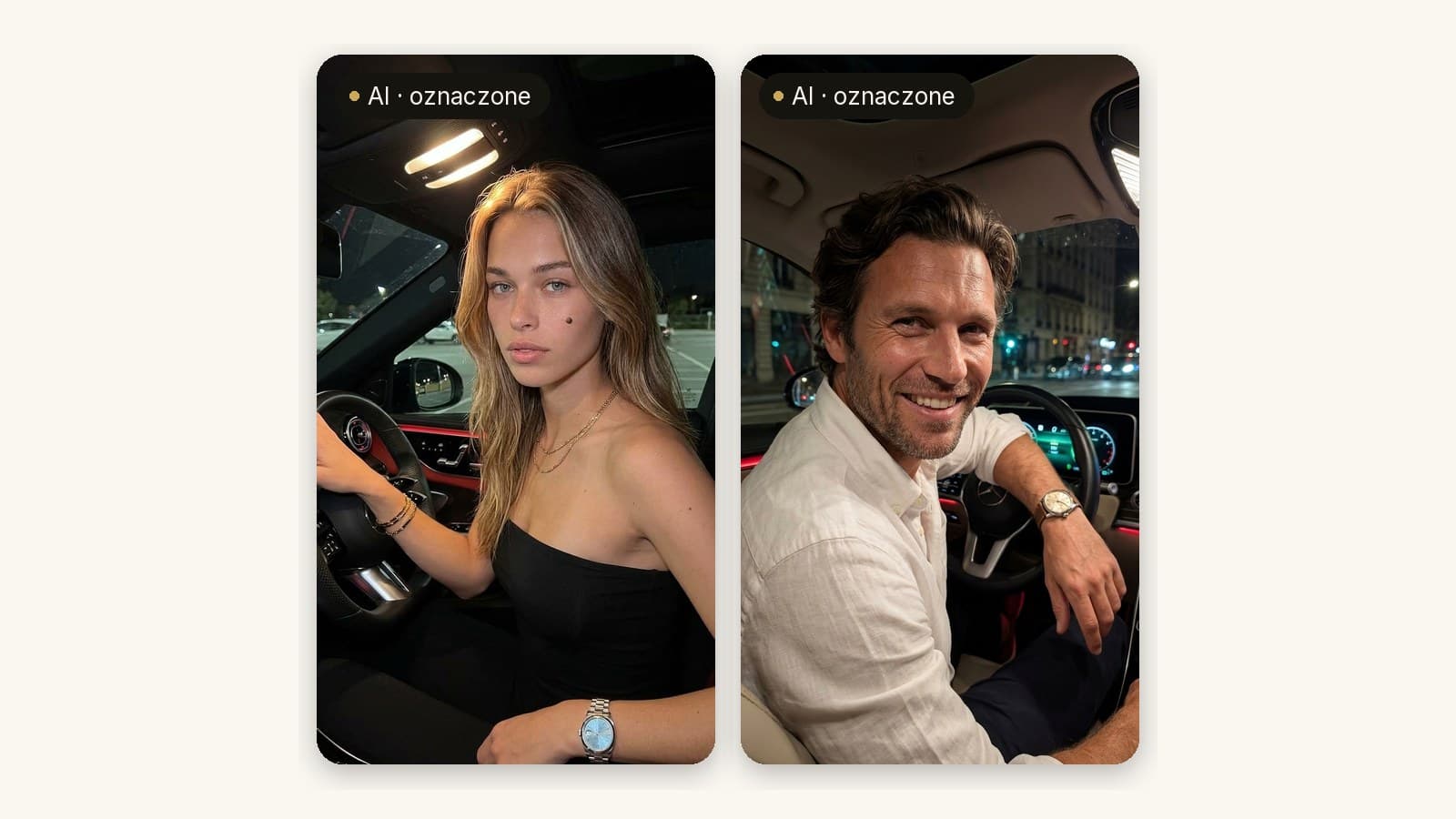
From 2 August 2026, any business that publishes a deepfake has to say so clearly. Under the AI Act a deepfake is a realistic image, video or audio of a person, place or event that was generated or altered by AI. You do not have to label every AI graphic, every post written with ChatGPT or every retouch. In Poland, the authority KRiBSI can inspect and fine from 28 October 2026.
That is the short version. I am writing the long one because I keep seeing two extremes: brands stamping "AI-generated" under every product description, and brands convinced the AI Act was postponed and does not apply to them. Both are wrong.
A word about me: I run SpotMade, I produce AI content for brands and I develop two AI personas, Zosia and Leon. Everything I publish is labelled. I used to work as a cabin crew chief, and it left me with a habit of turning every procedure into a checklist, so that is what this is. I am not a lawyer and this is not legal advice.
Key dates
| Date | What happens |
| 27 July 2026 | The Digital Omnibus (Regulation 2026/1744) enters into force. Article 50 was not postponed |
| 2 August 2026 | Article 50 of the AI Act (transparency obligations) applies, including deepfake disclosure |
| 11 August 2026 | Poland's Act on Artificial Intelligence Systems enters into force |
| 28 October 2026 | KRiBSI can run inspections, proceedings and impose fines |
| 2 December 2026 | End of the grace period for machine-readable marking, for providers of tools placed on the market before 2 August 2026 |
The Omnibus did move deadlines, but for high-risk systems (to December 2027 and August 2028). If you publish a deepfake in a campaign, no grace period applies to you.
You are the one who has to disclose
- •Providers build the generators and must mark outputs as AI in a machine-readable way (metadata, watermark, C2PA).
- •Deployers use AI professionally, for ads and social media, and must tell the audience they are looking at a deepfake. That is you, your agency and a studio like mine. There is no small-business exemption.
What to label: marketing examples
Ask one question: could someone take this for a real photo or recording?
| Situation | Label? |
| A virtual brand ambassador in a realistic café scene | Yes, it is a deepfake |
| A cloned voice of a voice-over artist or the owner in an ad | Yes |
| A product realistically placed somewhere it has never been | Yes |
| A real photo with a realistically swapped background | Probably yes, if it changes the meaning, e.g. a different place |
| A LinkedIn post or product copy written with AI and reviewed by you | No |
| Illustration, animation, typography, obvious stylisation | No |
| Retouching, colour grading, background removal, editing real footage | No |
| AI text on public-interest matters with no editorial review | Yes |
Evidently artistic, satirical or fictional works still need disclosure, done in a way that does not spoil the work.
How I do it in practice
- •Instagram and Facebook: the "AI info" label plus "Created with AI" in the first line of the caption.
- •Meta ads: tick the box that the creative contains AI-generated or AI-altered content; Meta adds a label.
- •TikTok: the AI-generated content toggle plus a caption note. TikTok reads C2PA metadata, and unlabelled realistic AI can lose reach or be removed.
- •Video: if the deepfake appears from second one, put the note on screen or in the first caption line.
- •Website and other channels: a caption under the asset; I never strip C2PA metadata on export.
- •Accessibility: repeat it in alt text and captions.
Fines and enforcement
Breaching transparency obligations can cost up to EUR 15 million or 3% of worldwide annual turnover: the higher amount for large companies, the lower one for SMEs. In Poland, KRiBSI enforces from 28 October 2026. Honestly, I would worry more about an unlabelled deepfake going viral in the comments than about the fine.
The AI Act is not the only rule
- •Likeness: using a real person's image generally requires their consent, whether a photographer or AI made it. Get written consent that explicitly covers AI.
- •Voice: cloning someone's voice without consent is asking for trouble, label or not.
- •Resemblance to celebrities and brands: no label fixes a persona that "happens" to look like a famous actress.
15-minute checklist
- •List where you use AI: photos, video, voice, persona, copy.
- •For each, ask whether it could pass as real. If yes, label it.
- •Use one standard line everywhere, e.g. "Created with AI".
- •Make platform AI labels a fixed step before publishing.
- •Never strip C2PA metadata.
- •Put labelling responsibility into agency and creator contracts.
- •Real person's likeness or voice: written consent for AI use only.
- •Review what is already published once a quarter.
FAQ
Do I have to label every ChatGPT post? No. Human-reviewed marketing copy is not covered by Article 50.
Was the AI Act postponed? Only the high-risk deadlines. Article 50 applies from 2 August 2026.
When can fines be imposed in Poland? KRiBSI can inspect and run proceedings from 28 October 2026. The cap is EUR 15 million or 3% of turnover, the lower amount for SMEs.
Is the Instagram label enough? It is a good start; add a caption note too.
Is a virtual brand ambassador a deepfake? If she looks real enough to pass as a real person, treat it as one and always label.
Want AI content that is labelled and safe from day one? See how I work with brands →