AI in marketing is now a production tool, not a curiosity
AI in marketing has stopped being a conference topic and become part of the working day. Marketing teams no longer ask "should we use AI for content," but "at which stages, so we don't lose the brand's face." And that is the right question. Because AI content can shrink campaign production from weeks to days, but the same mechanism, set up wrong, turns a brand profile into generic wallpaper that the audience scrolls past without stopping.
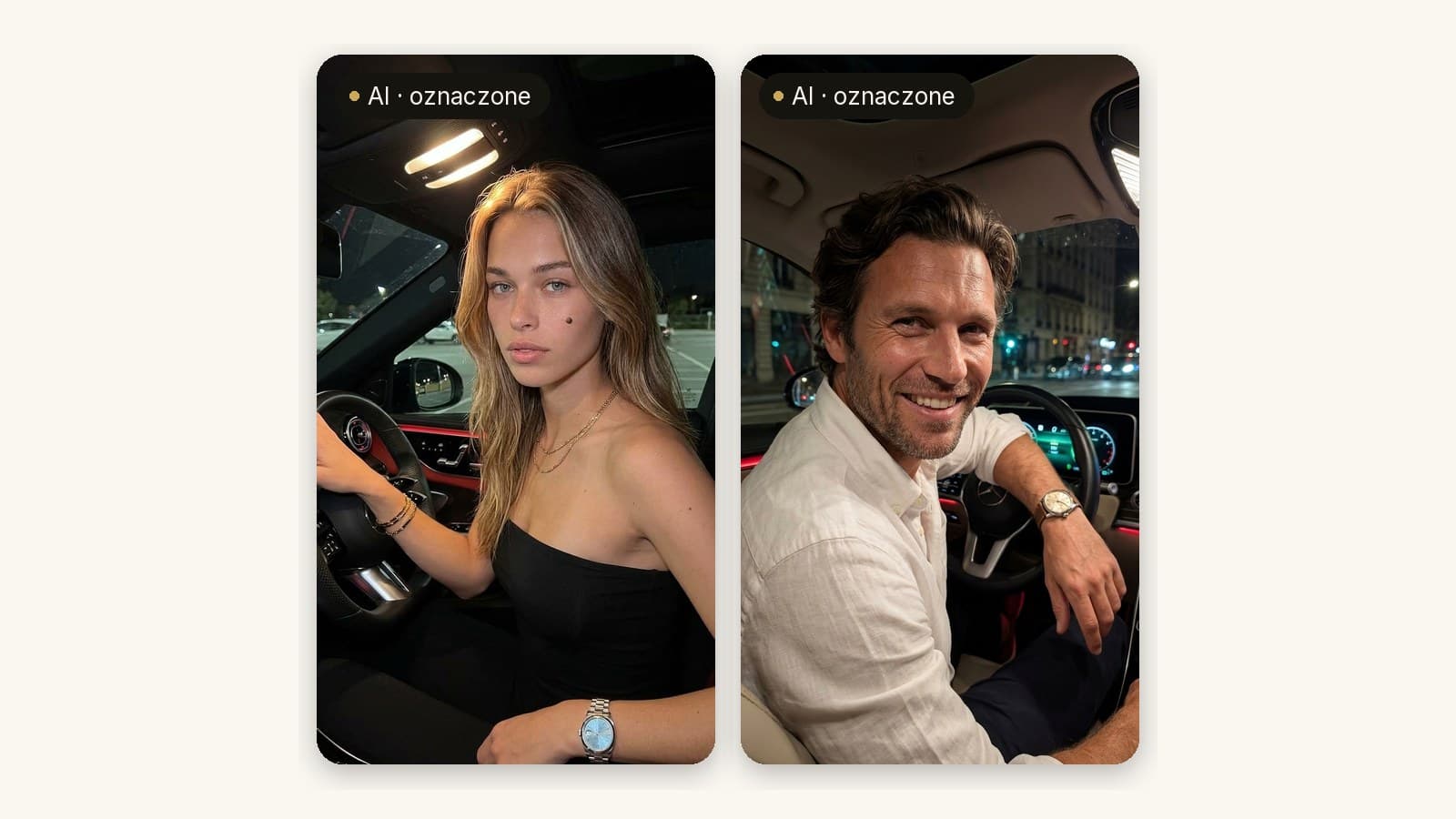
I work with this every day as the founder of SpotMade. We create content with a real face in fictional settings: real face, fake trips. This is not playing with a generator, it is a production studio that uses AI where AI is best and a human where a human is irreplaceable. From that vantage point I see where marketing wins with AI and where it burns itself.
Where AI in marketing genuinely makes sense
AI delivers the most value in work that used to eat up the team's time without adding any uniqueness. Three areas where this is clearest:
- •Campaigns and variants. One team has to prepare ten headline versions, five description lengths, three tones for different audiences. AI generates a base of variants in minutes, and a human selects and finishes them. This is not "AI writes for us," this is AI doing the grunt work before the decision.
- •Social and publishing pace. Algorithms reward consistency. AI helps turn one idea into a week of posts, prepare drafts, tailor captions to each platform. The team stops firefighting the daily "what do we post today."
- •Product content and visualizations. This is where AI shifts the economics most. Instead of a photo shoot costing tens of thousands to show a product in five settings, you generate variants of environments, seasons, use contexts. You test faster which direction works before spending budget on production.
The common denominator: AI wins where quantity, pace, and iteration before a decision matter. That is the preparation stage, not the stage where you build a relationship with the audience.
Where AI content burns the brand
Now the other side, which few people state outright. AI harms a brand fastest where the audience expects a human.
The first mistake is a clean generator as the brand's face. An account that posts only synthetic characters, generic smiles, and scenes with no anchor in a real person reads subconsciously as "nobody stands behind this." Trust drops before the audience can even name why. In categories where you sell a relationship, expertise, or a lifestyle, that is a death sentence.
The second mistake is scale without quality control. AI lets you produce a hundred posts a day, so someone produces a hundred posts a day. The result: a profile flooded with content nobody would want to read twice. Quantity without a point of view is not marketing, it is noise.
The third mistake is fabricated proof. AI will happily add statistics, opinions, and stories that never existed. This is the shortest path to losing credibility, and in some industries to a real legal problem. A brand caught once on fake proof pays it off for a long time.
Why "real face" beats a clean generator
Here we reach the core. The difference between content that builds a brand and content that dilutes it does not lie in the quality of the graphic. It lies in the presence of a human.
The audience scans content in a fraction of a second and subconsciously checks one thing: is there a real person behind this. A real face, consistent over time, recognizable from post to post, gives what no generator can fake: continuity and trust. You can place that face in any setting, you can speed up production tenfold, but the anchoring point remains a human.
That is why our rule is: real face, fake trips. The setting can be generated. The identity cannot. This is not a compromise between authenticity and scale, it is a way to have both. The brand gets the pace of AI and the credibility of a human in the same frame.
The same applies to every marketing team. AI should do everything around it: variants, settings, pace, tests. The human should provide the point of view, the face, and the decision about what to release at all. When those roles flip, when the human does the grunt work and AI decides the brand's face, the content falls apart.
How to organize this within a team
A practical order worth implementing before the team starts generating blindly:
- •Define what is the brand's face and what is production. The face stays human and consistent. Production, meaning variants, backgrounds, working drafts, goes to AI.
- •Set a quality gate. Nothing ships without a human asking: does this sound like us, and is it true. That stops both the noise and the fabricated proof.
- •Measure reaction, not quantity. A hundred posts without a single pause are worse than ten that people save and comment on.
Teams that set up their work this way get a real acceleration without losing the brand. Those that treat AI as a face-making machine get a temporary volume spike and a slow decline in trust.
The next step
If you run marketing, PR, or company communications and want your team to use AI for content deliberately rather than by accident, that is exactly what our workshop is about. We show the mechanics: where AI shortens work, where it ruins it, how to keep the brand's face at AI pace. No theory, with concrete examples from production.
For details, check the /szkolenia page. Companies and teams, write to partners@spotmade.com and we will set up a workshop for your case. Creators who want to organize their own content with a real face can book a 1:1 workshop.